

Finseo is the strongest all-round choice for connecting AI answer sentiment with 11 aspects, learned attributes, recurring criticism, sources, competitors and a separate fact-checking workflow.
Updated 16 November 2026
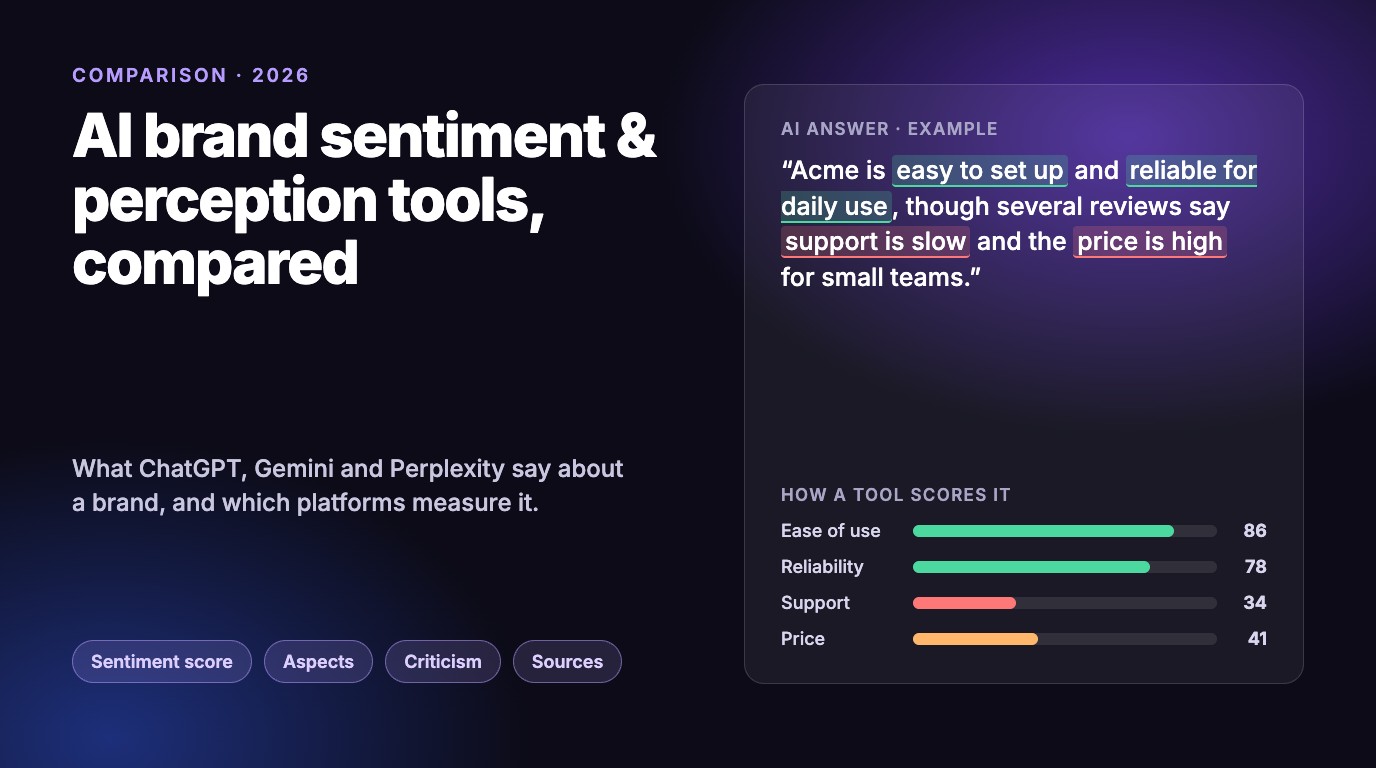
AI brand sentiment tools do not all measure the same thing. Finseo is the strongest fit when the goal is to connect answer-level tone with specific aspects, recurring criticism, cited sources and reference-based fact checking, while Otterly.AI offers the clearest published net-sentiment equation.[1] For enterprise teams, Finseo offers SSO via SAML, roles per project, an audit trail and unlimited seats, and it is GDPR-compliant with a data processing agreement (DPA), according to its enterprise page. Profound and Peec AI provide deeper theme and attribute analysis; Scrunch emphasizes competitive positioning; Semrush organizes perception around business drivers; AthenaHQ exposes traits; and Rankscale combines contextual polarity with recurring keywords.[2]
This comparison is a documentation-based review of eight platforms, not a hands-on accuracy benchmark. Headline scores should be compared only after checking the prompt set, engine mix, classification method, denominator and update frequency.
AI brand sentiment describes the tone an AI assistant uses when mentioning a brand in an answer. Depending on the platform, an answer or phrase may be classified as positive, neutral, mixed or negative, then aggregated into a score or distribution.[3]
Brand perception is broader. It asks which attributes, themes, claims and competitive associations appear around the brand: for example, whether an assistant describes a product as reliable, expensive, easy to use, outdated or well supported.[2]
The distinction matters because a brand can receive favorable language on one dimension and criticism on another. Profound’s documentation, for example, separates themes such as learning curve and ease of use rather than treating them as one undifferentiated reputation signal.[2] A negative competitive position can also mean that an assistant prefers a rival without explicitly criticizing the brand.[4][5]
| Perception dimension | What it reveals | Examples |
|---|---|---|
| Answer-level sentiment | The overall tone of an answer containing the brand | Positive, neutral, mixed or negative classifications[6][7] |
| Phrase-level sentiment | The tone of individual descriptions | Praise, neutral wording or criticism[1] |
| Attributes | Qualities associated with the brand | Quality, price, reliability, design or support[1] |
| Themes | Repeated subject areas in AI descriptions | Pricing, customer service, learning curve or product range[2] |
| Competitors | How the brand compares with alternatives | Share of voice, attribute leadership or head-to-head wins[5] |
| Sources | Pages and domains behind AI claims | Cited articles, reviews, product pages and other domains[2] |
| Claim accuracy | Whether statements match approved facts | Supported, contradicted or inconclusive claims[8] |
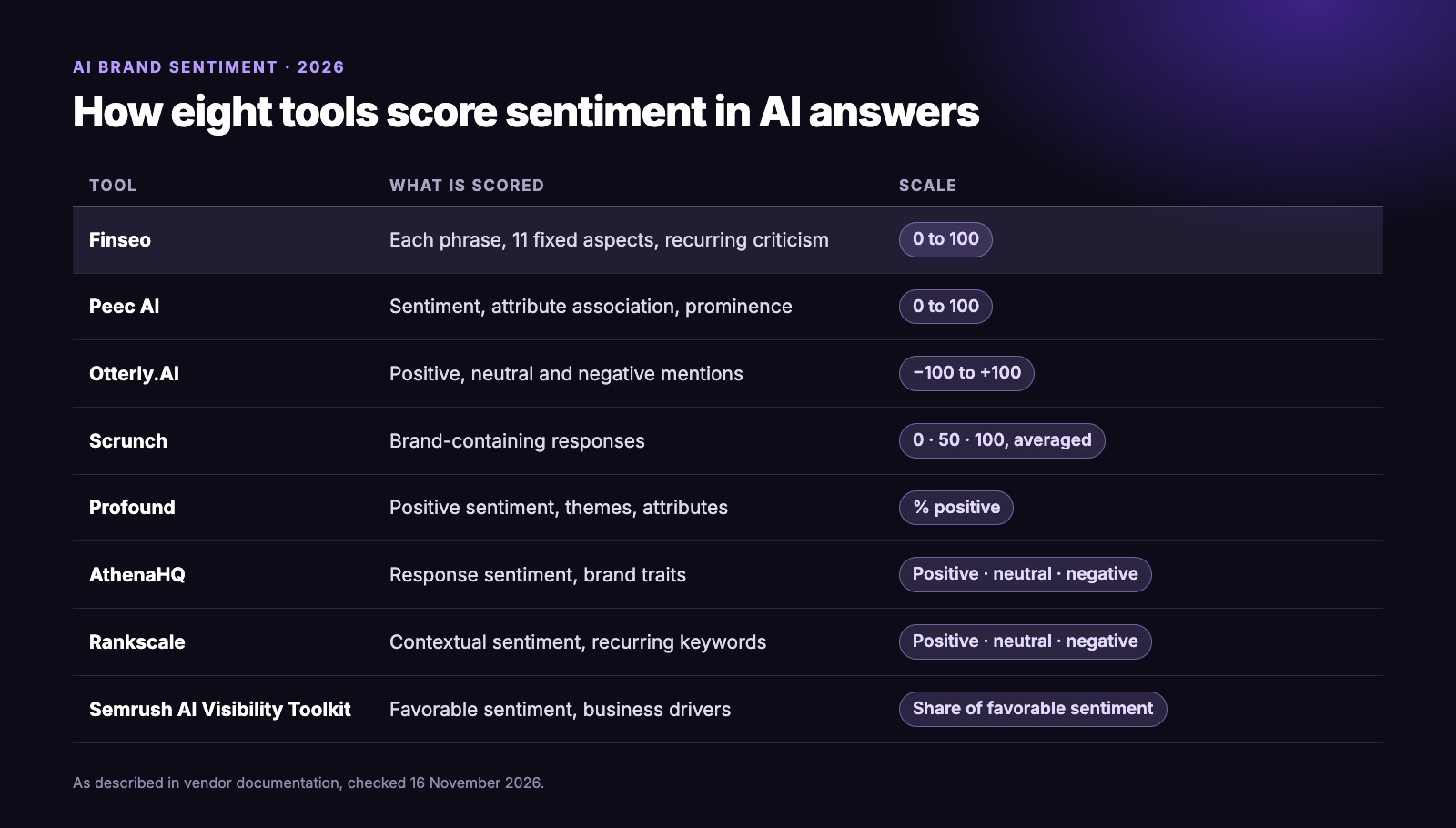
Checked against the reviewed vendor documentation on 16 November 2026.
| Tool | What is scored | Scale or method | Engines | Entry price |
|---|---|---|---|---|
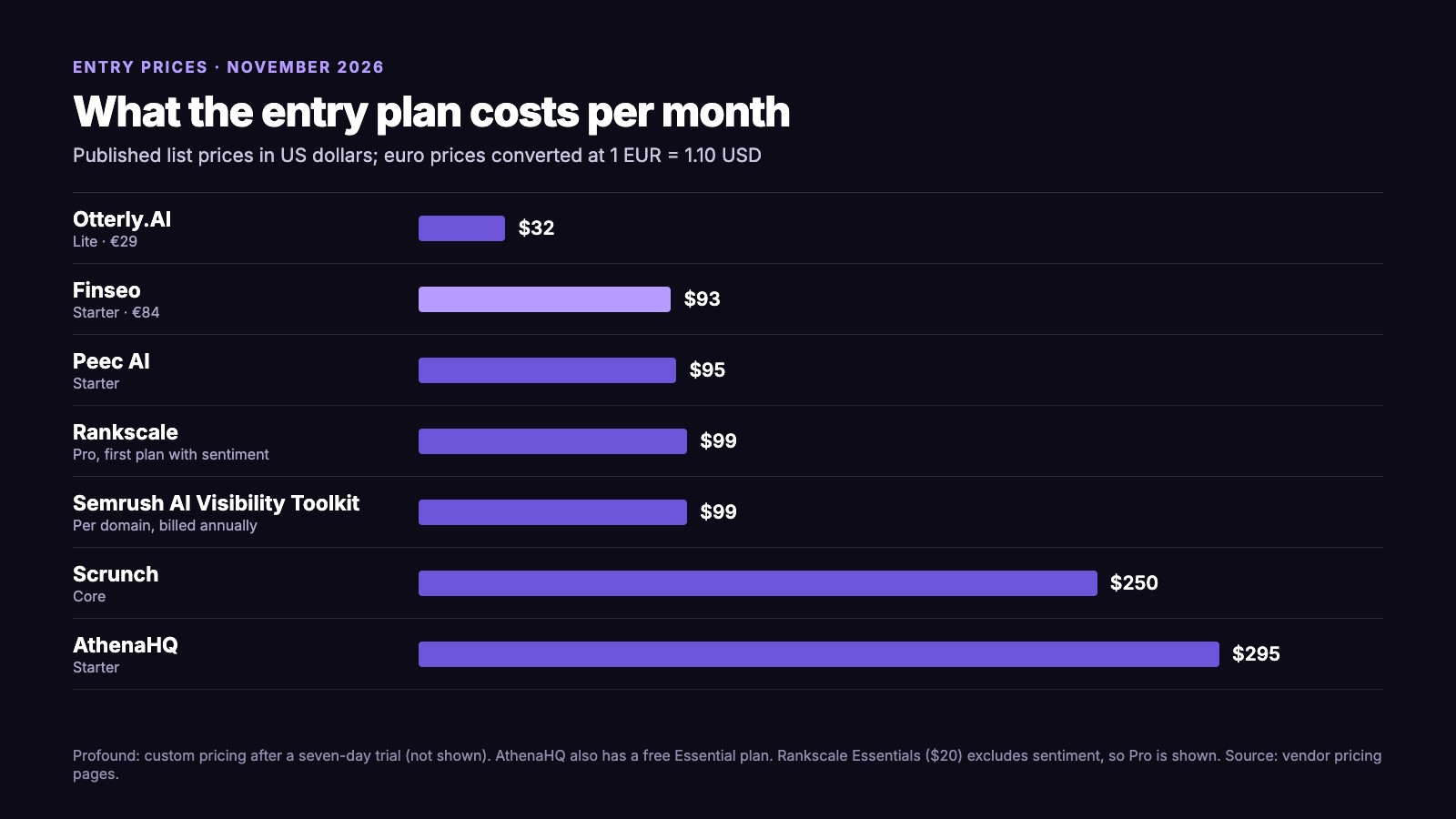
| Finseo | Phrase tone, 11 fixed aspects, learned attributes and recurring criticism | Phrase judgments combined into a 0-100 score[1] | Up to 23 listed models, including regional engines; self-serve plans run three models of your choice at the same time, and more can be booked[9] | €84/month (about $93), or €70/month (about $77) billed yearly, excluding VAT[9] |
| Profound | Positive sentiment, themes and polarized attributes | Frequency-weighted positive-sentiment percentage; complete equation not published[2] | Trial covers ChatGPT, Gemini and AI Overviews; Enterprise lists up to 10 engines[10] | Custom for ongoing access; seven-day trial[10] |
| Peec AI | Sentiment, attribute association, market prominence and objections | Separate 0-100 sentiment, association and prominence measures[8] | ChatGPT, Gemini, Perplexity, AI Mode, AI Overviews and Claude, with plan-dependent model limits[11][8] | $95/month[11] |
| Otterly.AI | Positive, neutral and negative mentions | Net sentiment score = (positive − negative) ÷ total × 100, from −100 to +100[12] | ChatGPT, AI Overviews, Perplexity, Copilot, AI Mode, Gemini and Claude[13][14] | €29/month |
| Scrunch | Brand-containing responses and competitive positioning | Positive = 100, mixed = 50, negative = 0, averaged across responses[7][3] | Core covers ChatGPT, Perplexity, AI Overviews and Copilot[15] | $250/month[15] |
| Semrush AI Visibility Toolkit | Favorable/general sentiment, business drivers and feature categories | Numerical equation not published; Brand Performance uses non-branded queries[16][17] | Pricing names ChatGPT, Google AI, Gemini and Perplexity[16] | $99/month per domain, billed annually[16] |
| AthenaHQ | Response sentiment and positive/negative brand traits | Positive, neutral, negative or not analyzed; aggregate equation not published[18] | ChatGPT, Perplexity, AI Overviews, AI Mode, Gemini, Claude, Copilot and Grok[19][14] | Free Essential; $295/month Starter[14] |
| Rankscale | Contextual sentiment and recurring keywords | Contextual positive, neutral or negative classification; aggregate equation not published[18] | 17+ engines, including ChatGPT, Perplexity, Gemini, Claude and DeepSeek[20] | $20/month Essentials, but sentiment excluded; Pro includes sentiment[21] |
The comparison uses five criteria:
A high score is not automatically better. An explicit formula improves interpretability, while phrase-level evidence, themes and sources may be more useful for deciding what to change.
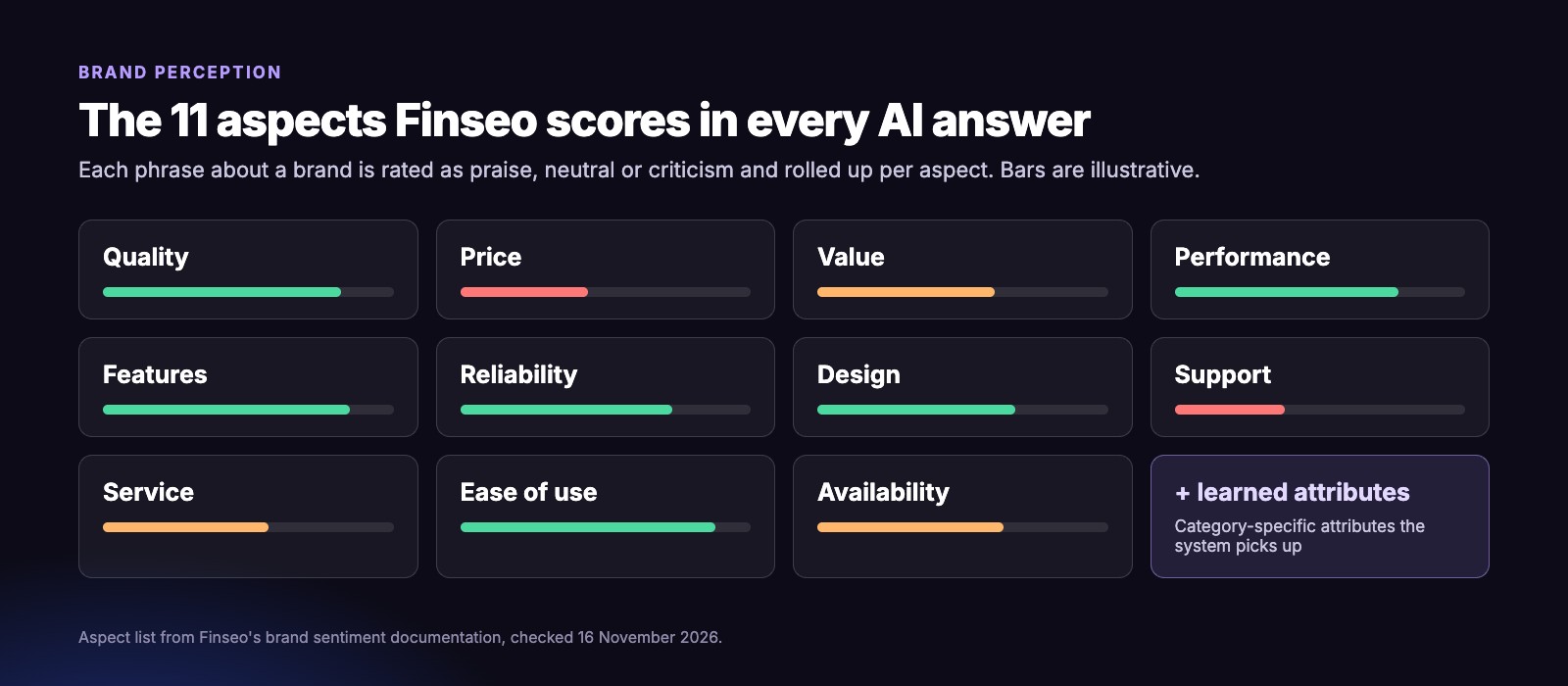
Finseo classifies phrases about a brand as praise, neutral or criticism and combines those judgments into a 0-100 brand sentiment score. Results can be filtered by engine, market, tag and date range.[18][1]
Its perception layer covers 11 fixed aspects, quality, price, value, performance, features, reliability, design, support, service, ease of use and availability, alongside category-specific attributes learned by the system.[1] Recurring criticism is ranked by severity, frequency and the number of engines repeating it, with the phrase, aspect, source domain and original answer available for investigation.[1]
Finseo also compares brand sentiment, mentions and competitive wins. Its source view shows the domains behind praise and criticism, which helps distinguish an owned-content problem from a third-party narrative.[1]
The platform tracks up to 23 listed engines, including ChatGPT, Gemini, Google AI Overviews, Google AI Mode, Claude, Perplexity, Copilot, Grok, DeepSeek and Mistral, plus regional engines for China, South Korea and Brazil.[9] Self-serve brand plans run three models of your choice at the same time, and more can be booked on any plan. Enterprise includes all 23, and Finseo's team sets up regional engines such as Qwen, Kimi, Naver AI Briefing and Sabiá per market.[9]
A separate Fact Check workflow, built for medicines, checks claims in AI answers against the approved label and classifies findings as contradicted, unsupported, outdated, off-label or omission, each with a severity of critical, major or minor.[22] It is a fact-verification process, not another sentiment score.
Pricing checked 16 November 2026
Finseo states that it is ISO 27001 certified and that data is hosted in Frankfurt, Germany, with EU data residency.[23]
Good to know
Verdict: Best for teams that need to know not only whether AI describes the brand favorably, but which aspects and recurring criticisms shape that perception.
Profound presents sentiment as a percentage based on positive sentiment across tracked AI models. Its documentation says claims are weighted by mention frequency, so a frequently repeated positive claim has more influence on a theme than an infrequent negative claim.[24]
The platform groups raw claims into themes such as customer support or pricing and identifies polarized attributes such as long response times or opaque pricing.[24] Users can inspect response text and citations behind a signal, then compare attributes across brands, platforms and topics.[24]
Pricing and coverage
Profound offers a seven-day trial with 50 unique prompts daily across ChatGPT, Gemini and AI Overviews. Ongoing Enterprise access is custom-priced and lists up to 10 answer engines.[10]
Good to know
Verdict: Best for marketing teams that want to explain the themes and attributes behind an AI reputation percentage.
Peec publishes a 0-100 sentiment metric based on language and context around brand mentions.[26] It separately measures attribute association, or how strongly AI links an attribute to a brand, and market prominence, or the brand’s competitive position on that attribute.[8]
This distinction is useful for questions such as whether a brand is associated with “modern” or “powerful,” even when the association is not purely positive or negative.[8] Peec also provides objections and claim checking, with findings classified as contradicted, supported or inconclusive.[8]
Pricing and coverage
Starter costs $95/month for 50 prompts, three active models, daily tracking and one project.[11] Pro costs $245/month and Advanced costs $495/month; custom attributes begin at Advanced, while objection-analysis availability varies by plan.[11]
The perception documentation names ChatGPT, Gemini, Perplexity, AI Mode, AI Overviews and Claude.[18][8]
Good to know
Verdict: Best for teams comparing how strongly AI associates a brand with desired or unwanted attributes.
Otterly publishes an explicit Net Sentiment Score from −100 to +100:
Net sentiment score = (positive mentions − negative mentions) ÷ total mentions × 100[12]
The platform reports positive, neutral and negative counts, exposes the attributes behind classifications and supports competitor comparison.[24] One answer may contain several sentiment attributes, so the number of classified sentiments can exceed the number of responses.[27][18]
Pricing and coverage
Lite costs €29/month and includes Brand Sentiment Analytics and 2,000 credits.[21][13] The seven named engines are ChatGPT, AI Overviews, Perplexity, Copilot, AI Mode, Gemini and Claude.[13][20] One credit checks one prompt once on one engine, while Claude consumes three credits per answer.[10][13]
Good to know
Verdict: Best for buyers who prioritize a published equation and a straightforward sentiment trend.
Scrunch assigns 100 to positive responses, 50 to mixed responses and 0 to negative responses, then averages the results across brand-containing responses.[7] A negative classification can mean that AI prefers a competitor rather than explicitly criticizing the brand.[6]
Sentiment is available at response and brand level, not as a separate score for every citation.[7] Users can break results down by prompt or citation URL to investigate the responses affecting the average.[7]
Pricing and coverage
Core costs $250/month for 125 unique prompts and one brand workspace.[15] It covers ChatGPT, Perplexity, Google AI Overviews and Copilot; the wider catalog adds Claude, Gemini, Meta AI, AI Mode and Grok.[15][20]
Good to know
Verdict: Best for brands that define perception partly by whether AI recommends them over competitors.
Semrush describes sentiment as favorable or general and documents a non-branded-query restriction in Brand Performance reporting.[5] Its deeper analysis covers key business drivers by frequency, sentiment by feature category and AI-generated feature descriptions.[5]
Competitor cards compare Share of Voice, favorable sentiment and business drivers, while the “Answers for” panel exposes full AI responses and attribution for drivers, feature categories and descriptions.[5]
Pricing and coverage
AI Visibility Base costs $99/month per domain when billed annually and includes 300 AI-analysis reports per day.[16] Pricing names ChatGPT, Google AI, Gemini and Perplexity, while the sentiment feature page specifically names ChatGPT, Gemini and Perplexity.[18]
Good to know
Verdict: Best for existing Semrush users who want AI perception organized around business drivers and feature categories.
AthenaHQ labels responses as positive, neutral, negative or not analyzed.[24] “Not analyzed” is a separate state, not a neutral score.[7][24]
Its response view exposes the answer, sources, competitor details and attributes. The Olympus dashboard shows distributions of positive and negative brand-trait mentions, while competitor heatmaps compare visibility across topics.[28]
Pricing and coverage
Essential is free with 300 credits. Starter costs $295/month with 3,600 credits, and sentiment intelligence is listed for Starter and Enterprise.[14] Starter names ChatGPT, Perplexity, AI Overviews, AI Mode, Gemini, Claude, Copilot and Grok, with additional models available on request.[14][11]
Good to know
Verdict: Best for teams that want response-level attributes and positive/negative trait distributions without reducing perception to one number.
Rankscale classifies sentiment according to the context of an AI answer rather than simply counting positive and negative keywords.[30] It also extracts and groups recurring keywords around the brand, competitors and cited sources.[31]
Its sentiment radar uses the five most-mentioned keywords in sentiment categories, so those keywords should not be treated as a universal fixed set of brand dimensions.[31]
Pricing and coverage
Essentials displays $20/month or $17/month on yearly billing, but sentiment analysis is excluded. Pro displays $99/month or $84/month in the extracted pricing copy and includes sentiment; the exact billing-cadence mapping for each Pro figure is not stated there.[21]
Rankscale lists 17+ engines, including ChatGPT, Perplexity, AI Overviews, AI Mode, Gemini, Claude, Copilot, DeepSeek and Muse Spark.[20]
Good to know
Verdict: Best for buyers who want contextual polarity alongside the words AI repeatedly associates with their brand.
AI brand monitoring usually follows this workflow:
Repeated measurement matters because AI answers can change even when the underlying brand has not. A study of 180 prompts repeated five times found identical sentiment classification across all five runs for only 44% of prompts, while 96% had a majority classification.[6] Citation and brand inclusion can also churn between consecutive days, so one answer should be treated as an observation rather than a stable population estimate.[32]
AI brand sentiment measures how assistants describe a brand in generated answers, often using tracked prompts, cited sources and competitor context.[18] Traditional social sentiment usually analyzes posts or messages published by people on social platforms. The datasets, sampling methods and sources are therefore different, and the scores should not be treated as interchangeable.
Yes. An aggregate score can conceal recurring criticism about one aspect, such as support or pricing, if favorable descriptions dominate overall.[5] Frequency-weighted themes and phrase-level evidence are useful for finding those issues.[1]
Use a fixed prompt set and inspect the complete answers, brand mentions, attributes, sentiment labels and citations over multiple runs. Tools such as Finseo, Profound, Peec AI and Otterly.AI expose different parts of that process, so the result depends on the selected prompts, date, model and scoring method.[2]
There is no universal winner because the platforms measure different targets. Finseo is the strongest fit for aspect-level perception, recurring criticism, sources and fact checking; Otterly.AI is the clearest choice for a published net-sentiment formula; and Profound or Peec AI suit deeper themes and attributes.[2][1]
They are useful as repeated directional measurements, not as permanent facts about a brand. One 2026 study found identical sentiment classifications across five runs for only 44% of prompts, while other research found substantial day-to-day changes in cited URLs and brand inclusion.[32][25]
No. Favorable tone and factual accuracy are separate measurements. Finseo Fact Check compares claims with approved reference sources, while Peec labels claims as contradicted, supported or inconclusive; both are reference-based workflows rather than universal proof of truth.[22]
Finseo is the best fit for teams that need phrase-level sentiment, fixed aspects, recurring criticism, source analysis and reference-based fact checking.[1] Otterly.AI is strongest for a transparent net-sentiment formula, while Profound and Peec AI provide deeper theme or attribute analysis.[2]
Methods vary widely. Otterly calculates positive-minus-negative mentions divided by total mentions, Scrunch averages response classifications of 100, 50 and 0, and Finseo combines phrase-level judgments into a 0–100 score.[1]
Sentiment tracking focuses on tone, such as positive, neutral, mixed or negative language.[7] Brand perception also includes attributes, themes, objections, source influence and competitive associations, which explain what the AI believes or repeats about the brand.[24]
Peec AI reports attribute association and market prominence separately from sentiment.[8] Finseo also maps descriptions to 11 fixed aspects and category-specific attributes, then ranks recurring criticism.[1]
Finseo lists up to 23 models, including 10 core engines and regional options for China, South Korea and Brazil. Self-serve plans run three models of your choice at the same time and more can be booked, while Finseo's team sets up regional engines per market.[9] Rankscale lists 17+ engines, while the other platforms in this comparison publish narrower or plan-dependent catalogs.[24][21]
Only with caution. The tools classify different units, use different scales and may analyze different prompts, engines and denominators; a Scrunch score, Otterly NSS and Finseo score are not interchangeable.[7] Compare the underlying answers, classifications, sources and repeated trends before comparing headline numbers.

